Technology uXtep
gait analysis
UMANA ® | uXtep
find the origin of your injuries
decipher your footprint

What do we do?
We decipher your gait to alleviate discomfort and injuries
At UMANA, we perform an advanced biomechanical gait analysis that, in addition to digital foot analysis, includes a comprehensive dynamic evaluation of 3D movement, stability, and proprioception. We analyze more than 50 biomechanical parameters of the foot, gait, and also the back to diagnose the origin of your injuries. In this way, we provide personalized solutions to prevent and treat your conditions:
- Functional rehabilitation: we focus on the specific exercises you need to correct your biomechanical alterations
- Custom orthotics: we design tailor-made orthopedic insoles that correct your deviations and improve your comfort
- Specialized footwear: in addition, to improve your comfort when walking, we recommend the footwear best suited to your characteristics
Technology-Based Company
Rated since 2006Biomechanical Analysis Health Center
Authorized since 2008Biomechanical Official Laboratory TC Novex
Partner since 2018Applied Biomechanics Research Center
+20 years of research
Who is it for?
frequent cases
Our biomechanical gait analysis allows us to help patients with foot, leg, and back problems, as well as individuals at risk of developing them:
- people with high/arched feet or flat feet
- patients with joint pain
- pronators and supinators
- children with poor gait patterns
- unclear or imprecise diagnoses
- workers with high physical load
- pregnant women
- amateur and elite athletes
- patients undergoing rehabilitation
- people with diabetes
- patients with foot pathologies (plantar fasciitis, metatarsalgia, heel spur, sesamoiditis, hallux valgus, claw toes…)

What does our gait analysis provide?
Our biomechanical study of the foot and gait provides a new approach to musculoskeletal diagnosis.
It allows us to perform a dynamic diagnosis of your injuries, identify the origin of pain, measure functional limitations, and understand the best way to treat and resolve them.
It is therefore the perfect complement to medical imaging tests (such as X-rays, MRI, CT scans, and ultrasounds), which only assess the condition of joint structures (bones, tendons, ligaments…).

leading experts in biomechanics in Spain
Speakers and scientific communicators at the National Congress of Podiatry
At UMANA ®, we are specialists in gait and footwear biomechanics. Over the past 5 years, thanks to our knowledge and research, we have become a national reference, being invited speakers at the National Podiatry Congress and other podiatry congresses and scientific events.
- 55th National Podiatry Congress | Zaragoza 2026
- IV National Freedom of Movement Congress | Alicante 2026
- 54th National Podiatry Congress | Las Palmas 2025
- III National Freedom of Movement Congress | Alicante 2025
- 53rd National Podiatry Congress | Cartagena 2024
- II National Freedom of Movement Congress | Alicante 2024
- 52nd National Podiatry Congress | Barcelona 2023
- 26th Scientific Podiatry Conference | Barcelona 2022
Why is uXtep technology different?
UMANA ® | uXtep
Decipher your gait and correct any imbalances
correct your gait

uXtep technology
biomechanical gait analysis

Our uXtep technology combines 3D motion analysis, dynamic posturography, force platforms, and in-shoe devices to comprehensively evaluate the patient’s gait.
We measure over 100 biomechanical parameters related to movement and foot contact during the gait cycle. All our tests are fast, non-invasive, and completely safe, combining measurements taken during natural walking and on a treadmill.
With uXtep, we can analyze any type of gait alteration, treating patients with joint, neurological, or post-surgical conditions.
In addition, the results allow a comprehensive analysis of gait patterns, providing objective measurements of foot anatomy, load distribution, stability and proprioception, stance duration and timing, pronation-supination tendencies, and joint deviations.
scientific basis
"It integrates big data, biomechanical calculation algorithms, and computational simulation."
multifactorial
”6 biomechanical tests to evaluate all the parameters that influence your gait pattern and injuries”
harmless
"protocols suitable for all ages and compatible with injury and recovery phases"
non-invasive
"It uses surface sensors that do not interfere with the biomechanics of gait."
100 parameters
"For a complete and fully personalized biomechanical study of foot strike and gait"
dynamic test
to perform the design of insoles based on the foot under real movement conditions rather than in a non-weight-bearing state
+ diagnosis
"It provides information that is not visible in traditional diagnostic imaging tests.(RX, RNM, TAC, ECO)”
footwear lab
"Calculate the technical characteristics of footwear compatible with you and your activity"
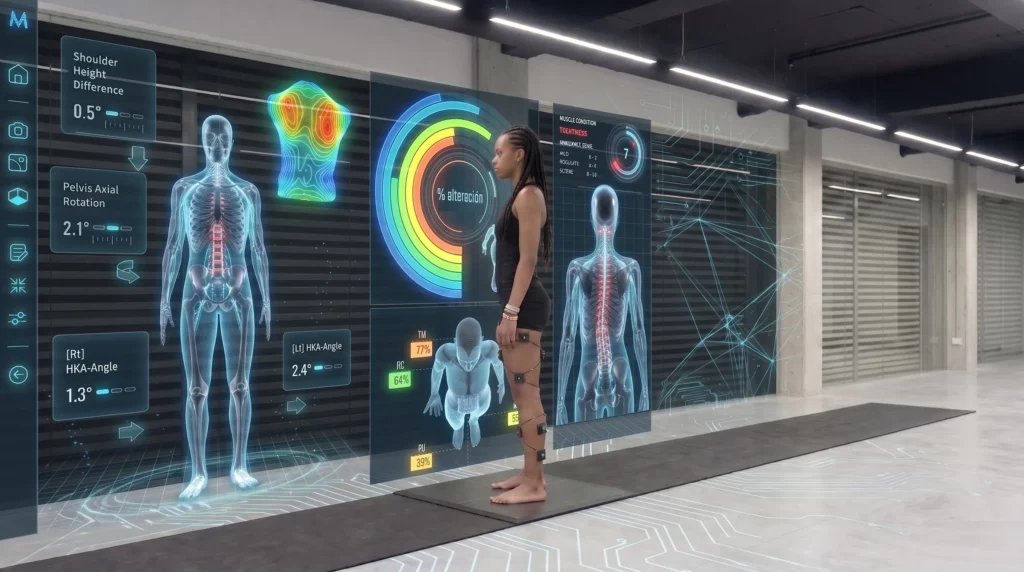
3D body scan
postural deviations
First, we perform a 3D analysis of body posture and spinal curvatures.
This study allows us to precisely measure the symmetry and alignment of body position, avoiding the use of radiation-based imaging techniques (X-rays, MRIs, etc.).
Thus, we detect excessive postural deviations (scoliosis, pelvic or scapular tilts, joint valgus and varus angles, etc.) that may have a direct influence on the injury potential of dynamic gait patterns, and even on biomechanical performance.

static analysis
load asymmetries
In this test, we analyze the static load distribution in the legs and also assess plantar support.
The information obtained allows us to identify load imbalances caused by structural asymmetries (lower limb length discrepancies, pelvic plane rotations, as well as deviations in joint axes).
In this way, we identify the deviations affecting the patient, which may lead to muscular compensations and chronic conditions.

digital pediography
anatomy of plantar support
With digital pedigraphy, we perform a computerized biomechanical study of the foot.
This study allows us to measure the anatomical characteristics of the foot and plantar support. In this way, we can determine the patient’s foot type and their anatomical load-bearing zones.
The information obtained is essential for the design of custom-made insoles when needed.

dynamic analysis
foot patterns
This study allows us to measure dynamic gait alterations.
We perform different natural walking tests and record dynamic plantar parameters (phase duration, propulsion forces, pronation-supination tendencies, etc.) using force platforms and in-shoe systems.
Each parameter is compared with population reference values, identifying differences that may indicate potentially harmful gait deviations.
The results are useful for defining personalized solutions (insoles, specialized footwear, and compensatory exercises), as well as for monitoring the patient’s progress throughout recovery.
3D motion analysis
joint deviations
We evaluate the patient’s 3D movement during the gait cycle.
During the different tests, precise motion data and joint deviations in the ankles, knees, and hips are recorded, detecting varus-valgus tendencies, asymmetries and movement restrictions, pelvic tilts and rotations, as well as deviations of the foot axis.
The results are key for the personalized prescription of insoles, rehabilitation exercises, and even specialized footwear.

stabilometry
proprioceptive ability
We perform a single-leg support test to evaluate the stability and proprioception of each leg.
To do this, we assess the patient’s response through multiple balance tests, modifying plantar support conditions and visual input. During each test, postural sway is recorded, and from this data we calculate the %stability and %proprioception relative to normal values.
In this way, it is possible to detect imbalances related to the accumulation of injuries or neurological dysfunctions.
How can uXtep technology help you?

personalized recovery
mobility, strength, and proprioception
We identify your structural alterations and biomechanical dysfunctions so you can eliminate the source of your discomfort and/or injuries. Our biomechanical study of gait and the foot allows us to understand the dysfunction of muscle groups involved during walking, leg asymmetries, pelvic rotations, and also muscle shortening.
In this way, we can guide your rehabilitation routines (strength and power training, proprioceptive improvement, flexibility, and even physiotherapy) to help prevent future injuries and recover from existing ones.

custom templates
biomechanical design
We design custom insoles that correct your biomechanical gait deviations to prevent future injuries and to treat and resolve existing ones.
We carry out the design of orthopedic insoles considering all necessary biomechanical factors: lifts for correcting limb length discrepancies, arch supports based on dynamic digital pedigraphy, corrective wedges for pronation or supination, metatarsal offloading, retrocapital supports, material densities according to your weight and intended use, etc.

footwear prescription
technical specifications
We determine which type of footwear best matches your gait, helping to minimize the negative effects of any biomechanical anomalies or individual characteristics.
Our biomechanical foot analysis allows us to understand your gait pattern (impact forces, plantar pressure distribution, gait stability, pronation level, contact and propulsion times…). Based on this pattern, we recommend the footwear that best suits you, considering sole geometries (thickness, drop, pronation control…), sole materials (rubber, high- or low-density PU, EVA…), and fastening systems (laces, Velcro…).