uXplore review
certify your injuries and aftereffects
In our clinic, specialized in biomechanical testing, we offer exclusive services for the assessment of injuries and sequelae. These evaluations are essential to understand the patient’s real progress and improve rehabilitation processes. Based on them, we prepare expert reports for the assessment of bodily harm for:
in cases of traffic accidents, occupational accidents, and occupational diseases.
In addition, these reports are supported by our biomechanical tests, which have full medical-legal validity and are accepted by forensic associations, the National Social Security Institute, and the courts.
It identifies dysfunctions beyond what is visible in imaging tests.
Biomechanical functional assessment tests are dynamic evaluations that measure recovery or sequelae after an injury.
These are harmless and non-invasive tests, applicable to patients of any age, including those with claustrophobia. All our tests are conducted in spacious laboratories, and our uXplore technology uses biometric devices that are imperceptible to the patient (cameras, markers, and platforms), which never cause discomfort or interfere with movement.
The objective is to accurately assess levels of mobility, strength, balance, and coordination, identifying musculoskeletal dysfunctions beyond what is visible in imaging tests (X-rays, MRIs, or ultrasounds).
The information obtained is essential to plan and guide rehabilitation treatments, determine work capacity, and assess sequelae and disabilities.
Clinical reliability and scientific evidence
The biomechanical tests we perform at UMANA have been published in Monograph No. 24 of the Legal and Forensic Medicine Bulletin of the AGMF. This publication certifies their levels of clinical reliability, scientific evidence, and legal validity.
In addition, the National Social Security Institute (INSS) and the Association of Work Accident Insurance Mutuas (AMAT) recognize biomechanical tests as medical examinations. In fact, the INSS/AMAT agreement has included them in the annex of medical tests since 2007.
These tests objectively define and quantify the patient’s sequelae and disability. Therefore, they are used as complementary medical evidence in expert reports for the assessment of bodily harm. Currently, there is extensive case law at the national level in both civil and labor jurisdictions.
uXplore diagnostics
detect the origin of your ailments
At UMANA, we offer exclusive advanced biomechanical diagnostic services. Patients from all over Spain come to our laboratories presenting with:
which often unknowingly cause their health problems.
We study cases daily of patients suffering from: vertigo, migraines, tinnitus, back and neck pain, sciatica, loss of strength in arms and hands, joint discomfort in hips, knees, ankles, and feet, and chronic fatigue, among others.
identifies imbalances, compensations, and musculoskeletal dysfunctions
Advanced diagnostic biomechanical studies are detailed analyses of human movement that allow us to detect alterations in gait, posture, and even oral function.
These are harmless and non-invasive tests that use biometric devices which never interfere with the patient’s movement (cameras, platforms, and skin-mounted sensors), making them suitable for all ages.
Their objective is to accurately evaluate imbalances, compensations, and musculoskeletal dysfunctions in order to obtain precise diagnoses and guide personalized treatments, while also enabling real-time monitoring and improvement.
Their applications range from rehabilitation to sports medicine, pediatrics, and dentistry.
Refine your diagnosis and improve your recovery
Through the differential diagnosis provided by our biomechanical studies of posture, gait, and TMJ, we can: measure the severity of your injuries/pathologies (objectively, reliably, and precisely)
determine their origin (distinguishing causes from symptoms)
prescribe the most effective personalized treatment (physiotherapy, dentistry, podiatry, optometry, functional rehabilitation…)
monitor your progress (optimizing your recovery in real time)
Why is uXplore technology different?
a new biomechanical dimension
Our uXplore technology performs biomechanical analysis with maximum precision and reliability. It includes more than 120 specific tests for all joints and types of injuries, also adaptable to the specific needs of each patient. To achieve this, it integrates 6 testing modules:
Based on solid scientific evidence, uXplore methods and techniques provide genuine diagnostic support and have proven clinical usefulness in the assessment of injuries and sequelae.
“Biomechanical tests for all joints, and even studies of specific pathologies”
“evaluating more than 600 parameters related to joint function, muscle function and coordination”
"Protocols suitable for all ages and compatible with injury and recovery phases"
"without needles or electric currents, and always in spacious areas that do not bother the patient"
“Compared with over 500 investigations, and published in the Official Bulletin of Legal and Forensic Medicine”
"Assessment of mobility, strength and muscle fatigue, pain, balance, stability, coordination, limping..."
"Adaptable to the characteristics of any patient, and even customized tests in each case"
“Objective and accurate information to aid in diagnosis, monitoring and rehabilitation approach”
joint-muscle balance
uXtrain protocols allow us to perform over 100 different biomechanical tests of joint-muscle balance, and even develop patient-specific tests when necessary.
We study all types of musculoskeletal injuries and have specific tests for the shoulder, elbow, wrist, forearm, hand, finger, hip, pelvis, knee, ankle, foot, TMJ, cervical, thoracic, and lumbar spine, as well as studies to assess possible radicular involvement.
In all cases, uXtrain integrates the measurement of range of motion, strength levels, and fatigue resistance, providing an objective and reliable assessment of the patient’s functional limitation.
assessment of pain
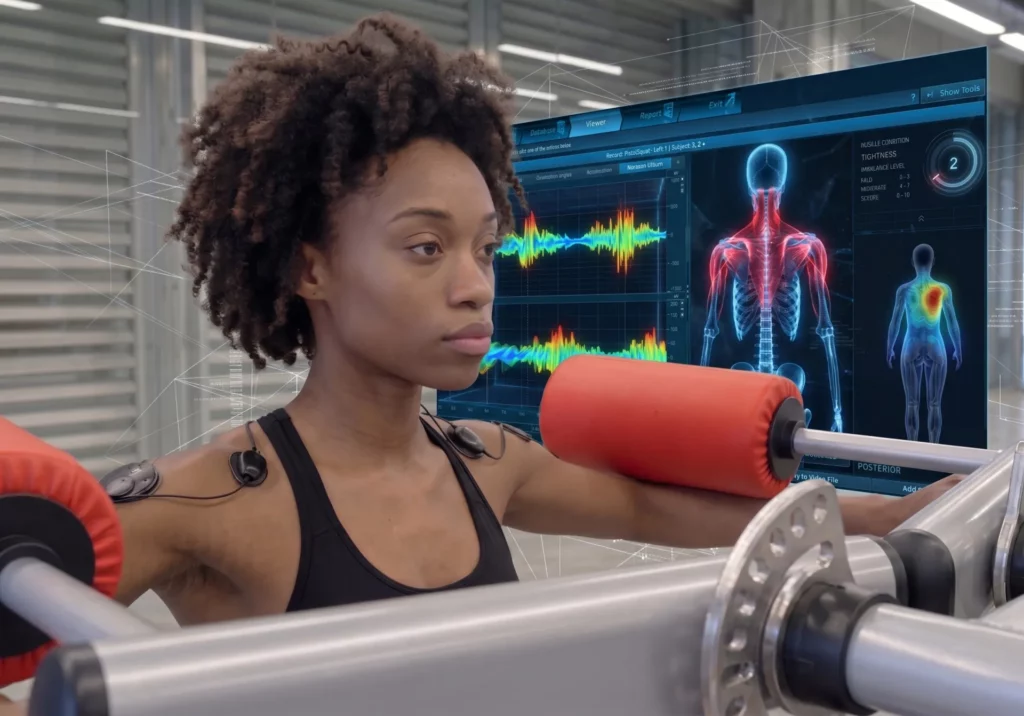
uXpain technology allows us to evaluate over 60 muscular parameters associated with pain and musculoskeletal dysfunction.
We study injuries in the arms, legs, jaw, and spine, always applying very fast, non-invasive clinical protocols that are completely safe for the patient, regardless of age.
The results obtained objectively assess the level of joint pain, providing a precise evaluation of the most affected movements and structures.
balance assessment
With uXtab, we can analyze multifactorial balance impairments through safe, simple testing protocols suitable for all ages.
We use 4D dynamic posturography techniques to evaluate patient stability under different conditions.
The results assess postural balance at all levels and provide objective measurements of static and dynamic balance percentages, offering a conclusive evaluation of the patient’s limitation in maintaining stability under both favorable and adverse conditions.
gait and foot strike analysis
Our uXtep system combines 3D motion analysis, dynamic posturography, force platforms, and in-shoe devices to evaluate the patient’s gait.
We measure over 100 biomechanical parameters related to movement and foot contact during the natural gait cycle and on a treadmill. With uXtep, we can analyze any type of gait disorder, treating patients with joint, neurological, or post-surgical conditions.
In addition, its results allow for an objective assessment of the patient’s ability to walk on smooth and stable surfaces, as well as on uneven and/or unstable terrain.
biomechanical posture study
Our uXtand body scanner integrates 3D morphological analysis systems, dynamic balance, and plantar dynamometry to comprehensively evaluate the patient’s posture.
We measure over 120 biomechanical parameters related to alignment and balance, allowing us to detect any type of postural alteration.
In addition, its results enable the examination of posture at all levels, providing precise measurements of asymmetry, as well as levels of sensory and podal interference, which helps to refine diagnoses and improve prescriptions.
biomechanical exploration of ATM
Our uXmile diagnostic device allows the evaluation of TMJ function and its influence on overall health.
We measure over 50 biomechanical parameters related to mobility, strength, and muscle activation, and we can also identify postural interferences originating from the TMJ that may affect the spine and lower limbs.
The results provide precise measurements of joint function and imbalance, and compare them to healthy population benchmarks, allowing us to complement diagnoses and better guide treatments.