Technology uComfort
do you know what it feels like?
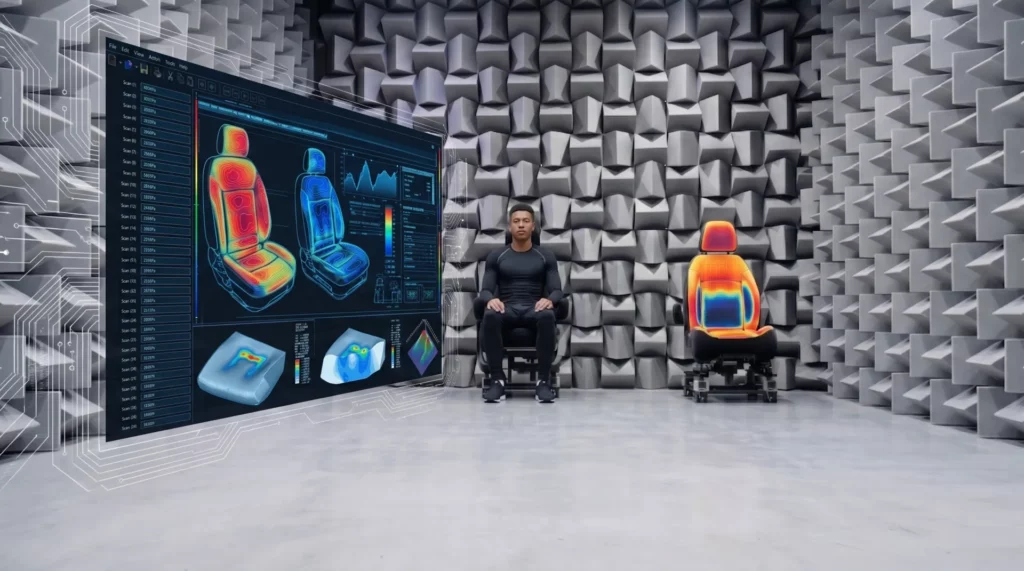
What do we do?
We measure comfort and improve your design
At UMANA, we help create products that are better adapted to people.
In an increasingly artificial world, where we interact with hundreds of products every day, users need to feel that these products align with our nature, that they are comfortable and healthy—in other words, more human.
We work to meet this need. We are specialists in ergonomic design: Human Design Studio&Lab.
Technology-Based Company
Rated since 2006Biomechanics Healthcare Center
Authorized since 2008Collaborator of Technology Centers
Consultants since 2010Applied Biomechanics Research Center
+20 years of research
uComfort technology
biomechanical product studies
We help you improve your product design with our uComfort technology, which evaluates its overall ergonomics through a set of studies:
- anthropometric
- pressure
- thermal
- postural
- muscular
- body mapping

human design services
Through our uComfort technology, we offer 4 Human Design services with significant benefits for product development:
- definition of ergonomic design requirements
- development of ergonomic designs
- prototype analysis
- final product validation
In addition, our biomechanical comfort validation reports have high value for marketing and commercialization.
















what makes uComfort technology different?

anthropometric adjustment
Global databases: We conduct analyses using global anthropometric databases. In addition, we adapt product design to the anthropometric profiles of different population segments and specific target groups (gender, age, etc.), which is key for global products and product lines with different sizes or configurations.
Anthropometry and design: We analyze and apply anatomical and postural data from target users to define optimal dimensions, adjustment ranges, and tolerances. This enables the design of products that geometrically adapt to a wide diversity of people, improving performance and user experience.
Interaction simulation: We use anthropometric models and numerical simulation tools to predict how users will interact with the product before manufacturing prototypes. This reduces development time, minimizes errors, and improves decision-making accuracy.

pressure study
contact comfort
Real-time pressure mapping: Contact pressure analysis is a key tool for evaluating comfort, weight distribution, and the body’s response to support surfaces. Using high-resolution sensors, we record pressure patterns in real time to detect overload areas, discomfort points, or lack of support. This allows us to understand the interaction between the user and the product and anticipate comfort issues.
Static and dynamic testing: In addition to static support, we analyze how pressures vary during real use: postural changes, repetitive movements, impacts, or exertion. This is especially useful for sports equipment, technical apparel, and seating for prolonged use.
Design optimization: We perform comparative tests between different product versions to evaluate improvements and validate design decisions. Pressure data enables precise adjustment of densities, geometries, materials, and support configurations.
EGA – T21 | Isringhaussen & Umana →

thermal analysis
Thermographic monitoring: Thermal comfort is a key factor in the user experience of any product in direct contact with the body. Using advanced thermal technology, we evaluate how heat flows between the user and the product, and analyze temperature evolution in contact areas to detect heat buildup, poorly ventilated zones, or surfaces with low dissipation capacity.
Analysis in real conditions: We study how temperature varies with movement, duration of use, and environmental conditions. These tests are carried out both in controlled laboratory settings and in real-world environments, including outdoor and professional contexts.
Comparative testing: We evaluate different configurations, densities, fabrics, or fillings to determine which offer the best thermal management. Our results enable the selection of more comfortable and efficient solutions, optimizing materials, structures, and designs to enhance thermal comfort and reduce perspiration.

postural assessment
3D postural measurement: The posture adopted by the user when interacting with a product influences comfort, performance, and long-term health. Using biomechanical 3D postural analysis techniques, we monitor joint angles, body alignments, and movements. This allows us to evaluate how the user sits, supports themselves, or moves on the product, identifying patterns and postural compensations.
Joint stress analysis: We relate objective data from the user’s 3D position to the actual stress-strain state experienced by the body. This enables us to identify areas of tension, fatigue points, and opportunities for improvement in product geometry.
Smart design: We test different product versions to detect forced postures, lack of support, or inadequate adjustments, and determine which configuration promotes a more stable and natural posture. This supports evidence-based design decisions and allows optimization to improve ergonomics and reduce fatigue.

muscle activity
sEMG recording: The muscle activity required by a product determines its comfort, efficiency, and ease of use. Using electromyography (EMG) technology and biomechanical analysis, we capture real-time activation of muscle groups to identify which muscles are working most and whether there are undesired muscular compensations.
Muscle tension analysis: Through sEMG recording, we analyze real muscle tension during movements, postural changes, repetitive efforts, or prolonged activities in both static and dynamic interaction with the product. This allows us to measure how muscles work, the level of effort required, which areas are overloaded, and how geometry or support influences overall comfort. This approach is essential for products subject to intensive use or sustained postures.
Advanced ergodesign: We analyze how muscle activity varies across different product versions, materials, or geometries. This enables us to determine which design best reduces physical load, supports postural control, and promotes more natural and efficient use.
← DRIVE-SEAT | CTAG & Umana
DRIVE-SEAT | CTAG & Umana ↑

BODYMAPPINGS
Ad-hoc 3D body mapping: Body mapping is an advanced tool that allows 3D representation of epithelial thermo-mechanical risk at any point of the body when using a product. We analyze how skin characteristics (according to user profile) and real usage conditions (sitting, lying, standing, walking, running, jumping…) influence the response of different user groups, understanding how they interact mechanically and thermally with the product and what their needs are.
Epithelial thermo-mechanical load analysis: We analyze how pressure, friction, temperature, and movement affect the skin during activities such as sitting, lying down, walking, or performing sports gestures. We identify critical areas and potential scenarios of irritation or injury.
Design requirements: This integrated approach allows us to define the ergonomic needs and specific design requirements of any user group and product. Based on this, we select the most suitable materials and adjust geometries to minimize epithelial risk and maximize comfort, creating safer and more comfortable solutions.
THERMO-XTREME | Lurbel & Umana →
THERMO-XTREME | Lurbel & Umana ↑
how can uComfort technology help you?

ERGONOMIC DESIGN REQUIREMENTS
User requirements research: We analyze the user profile (gender, age, body type…), weight and anthropometry, physical capabilities, and even cognitive aspects related to interaction with the product. This allows us to understand the user from an ergonomic perspective.
Analysis of usage conditions: We study the movements, postures, and forces required from the user under real usage conditions. This is carried out through observation, user interviews, body mapping, and biomechanical analysis of tasks and functions. The analysis covers both normal and critical usage scenarios.
Ergonomic Design Specification (EDS): Based on this, we develop the EDS, a document that establishes quantifiable Human Design criteria—anthropometric dimensions, allowable loads, usability—that will guide design decisions.

ERGONOMIC DESIGN
Initial sketches and mock-ups: First, we generate design ideas and solutions aimed at optimizing posture, effort, and ease of use (EDS requirements). We develop early sketches and mock-ups that explore geometries, interfaces, and grips based on anthropometry and biomechanics, and evaluate alternatives using ergonomic criteria to select the best design.
Final concept design: In this way, we create a definitive concept design focused on formal, functional, and biomechanical aspects. We also assess the feasibility of materials and processes while considering their impact on key parameters such as weight, aesthetics, and texture.
3D CAD: Finally, when required by the client, we develop 3D CAD designs of the concept and provide all the necessary technical documentation for prototype manufacturing.

prototype analysis
comfort assessment and redesign
Prototype comfort analysis: We objectively and reliably measure the comfort performance of the product through biomechanical studies using uComfort technology (anthropometric fit, pressure studies, thermal analysis, and postural and muscular evaluation).
Identification of weak points: This allows us to identify the “weak” points of the design and create a prioritized list of geometric parameters and material considerations that must be optimized, in balance with other development criteria such as production, aesthetics, and costs.
Ergonomic product redesign: Finally, we propose a definitive redesign that integrates all necessary modifications to overcome the comfort deficiencies identified in the prototypes.

product validation
biomechanical comfort guarantee
Biomechanical validation: We integrate the results of uComfort tests (anthropometry, pressure, temperature, posture, and muscle activity) to obtain a comprehensive view of user behavior. This ensures that the product provides appropriate levels of ergonomics and comfort.
Marketing and positioning: Our data-driven validations provide strong arguments for product communication: they demonstrate comfort improvements, justify competitive advantages, and support marketing claims with scientific evidence. This increases brand credibility and strengthens perceived value among consumers.
Industrial protection: Our biomechanical results act as technical support for patents, utility models, and industrial protection documentation. Objective validations demonstrate the product’s distinctive performance, help substantiate innovations, and facilitate registration processes with a clear and verifiable technical basis.
X-LITE HORSE-CARE | Moron & Umana →
X-LITE HORSE-CARE | Moron & Umana ↑